
Ripple said it has received full authorization under the EU’s MiCA crypto framework after Luxembourg’s financial regulator granted the company a Crypto Asset Service Provider (CASP) license.
The authorization follows Ripple’s initial approval in June and, together with the company’s existing Electronic Money Institution license, enables the blockchain payments company to offer regulated cryptocurrency services across the European Economic Area (EEA).
Ripple said this approval makes it one of a miniature number of digital asset companies fully authorized under MiCA. The company currently holds more than 75 regulatory licenses worldwide, including approval from the UK Financial Conduct Authority in January.
“This CASP authorization means Ripple enters the post-MiCA transition era fully compliant and ready to scale,” said Cassie Craddock, Ripple’s managing director for the UK and Europe.
Source: Cassie Craddock
Related: Binance outflows triple to $1.2 billion as ETH withdrawals hit three-year high
Europe begins to enforce MiCA crypto rules
Ripple’s approval follows the end of the European Union’s MiCA transition period on July 1, when crypto firms were required to obtain authorization or stop offering regulated services in the bloc. The framework allows authorized firms to broadly passport regulated crypto services across the EEA under a single licence.
On Friday, the European Securities and Markets Authority (ESMA) published an updated register listing 280 licensed crypto asset service providers. The total rose from 243 the week before after the addition of 37 companies, including Standard Chartered, FalconX and Sygnum Europe.
Not every company obtained MiCA authorization before the deadline. Binance, the world’s largest cryptocurrency exchange by trading volume, withdrew its MiCA application in Greece ahead of the July 1 transition and said it would seek authorization in another member state while taking steps to comply with the bloc’s recent rules.
The bloc has now entered the MiCA enforcement phase, with unauthorized crypto firms expected to shut down operations or face penalties. While ESMA coordinates supervision and maintains a register of authorized crypto firms in the bloc, day-to-day enforcement is handled by national regulators, meaning implementation is likely to vary between member states.
The Belgian Authority for Financial Services and Markets has already started applying the recent regulations. The regulator on Monday identified six crypto asset service providers that it found were operating without authorization and added them to its list of unauthorized crypto asset service providers.
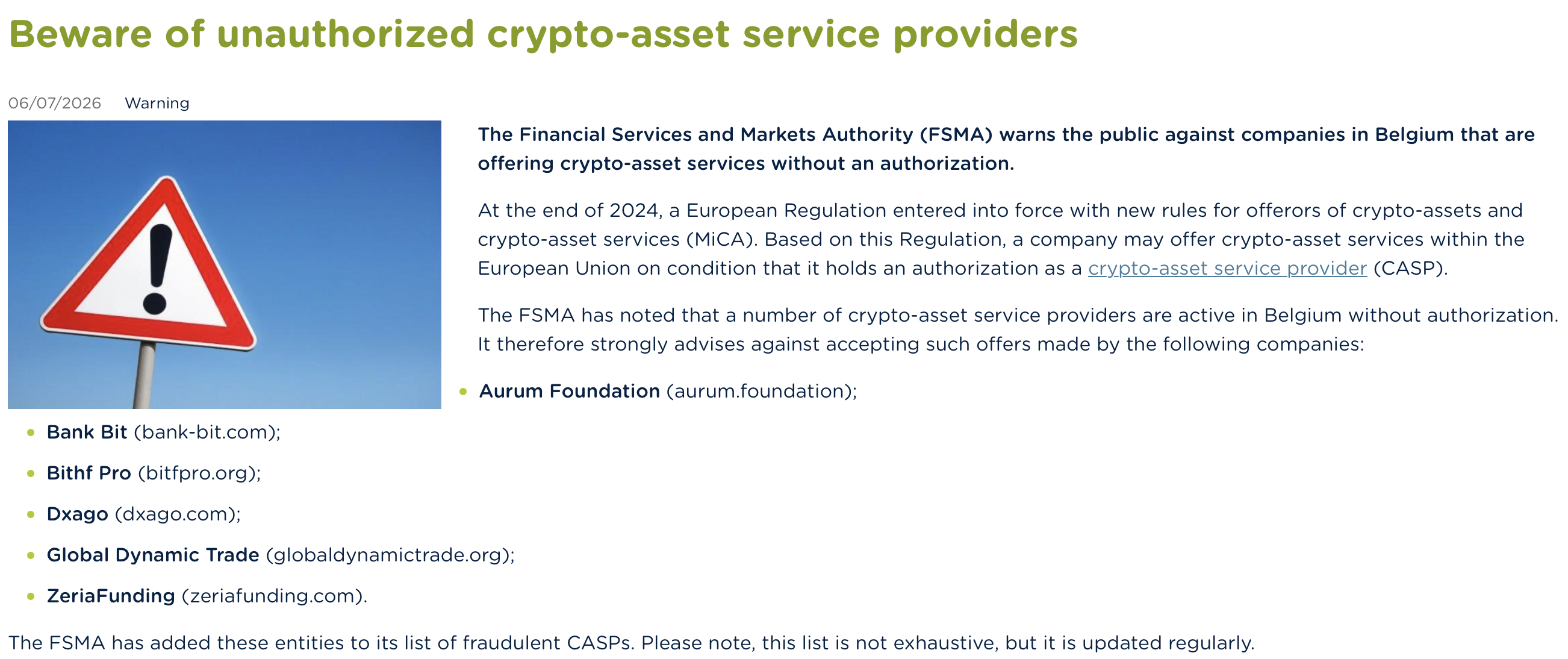
The Belgian FSMA warns against unauthorized cryptocurrency providers. Source: FSMA
Warehouse: Japanese pension fund tips 1% in cryptocurrencies, G7 calls for action against hackers NK: Asia Express
