
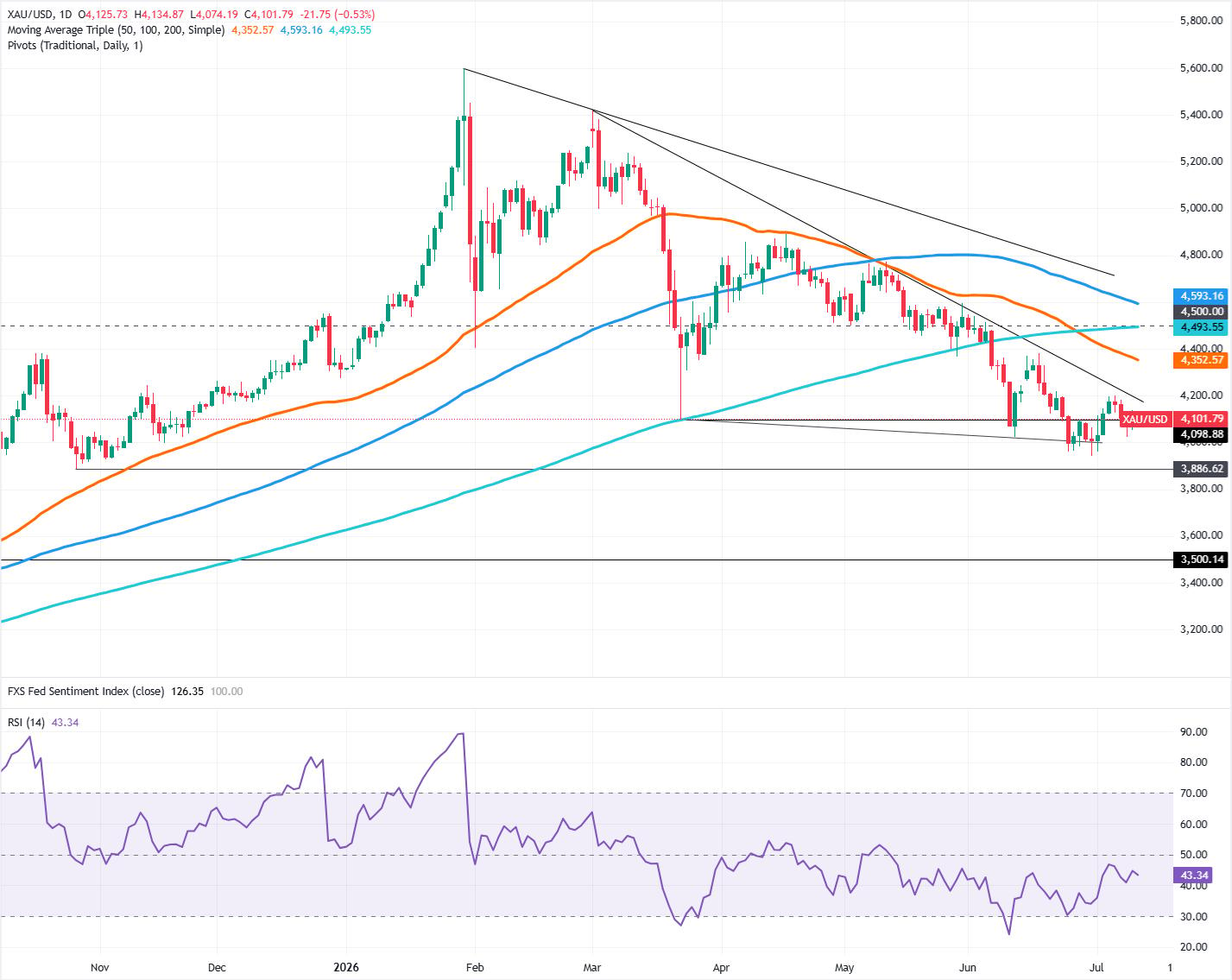
The price of gold (XAU/USD) falls on Friday during the North American session under pressure from US President Donald Trump’s comments allowing the resumption of US-Iran talks but repeating that the ceasefire “is over”. The XAU/USD pair is trading around $4,103, down 0.48%.
XAU/USD falls as renewed war poses risks of rising yields and the dollar
The yellow metal looks set to end the week with a 0.51% decline, fueled by the escalating conflict. The dollar pared its earlier losses as the US dollar index (DXY), which measures the dollar’s value against six currencies, remains unchanged at 100.94.
On his Truth Social account, President Trump wrote: “The Islamic Republic of Iran has asked us to continue ‘talks.’ We agreed to do this, but the United States told them in no uncertain terms that the ceasefire was over! Thank you for drawing attention to this issue. President DONALD J. TRUMP.”
U.S. Treasury yields rose following the post, with the 10-year T-bond rising 2 basis points to 4.569% on concerns that energy prices could rise, fueling fears of higher interest rates if hostilities continue.
Money markets have priced in an 80% chance of a Federal Reserve (Fed) interest rate increase at its September meeting. According to Prime Terminal data, the rates for the meeting scheduled for July 29 suggest that the central bank will maintain interest rates, and the chance of their increase is less than 34%.
The U.S. economy was muted this week, with the release of the minutes of the latest FOMC meetings, which were closely scrutinized for a lack of future guidance. The minutes show officials are concerned about inflation and “several participants” see an argument for raising interest rates.
On Thursday, the number of unemployed people fell to 215,000, below estimates of 218,000. and the previous reading of 217,000, which means the labor market is stable.
Now eyes turn to next week’s economic situation, with investors closely watching the release of U.S. inflation data and Federal Reserve Chairman Kevin Warsh’s testimony before the U.S. Congress.
XAU/USD Technical Outlook: Gold remains bearish below the 200-day SMA
The downtrend in gold remains unchanged as the market structure of a series of consecutive lower highs and lower lows remains intact. Additionally, momentum as measured by the Relative Strength Index (RSI) is decreasing and is currently in bearish territory, with the XAU spot price below the 200-day Simple Moving Average (SMA) at $4,493.
Given all three reasons, bullion prices may continue to decline, so any increase could be an opportunity for sellers.
The first support for XAU/USD will be the July 8 low at $4,021. Below is the June 30 low of $3,941, followed by the October 28, 2025 low of $3,886.
On the upside, if gold breaks above the downward resistance trend line near $4,200, it opens the door to breaking the $4,300 milestone. Above this area, the next ceiling level is the 200-day simple moving average (SMA) at $4,493.
Gold FAQs
Gold has played a key role in human history as it has been widely used as a store of value and a medium of exchange. Nowadays, beyond its luster and utilize in jewelry, the precious metal is widely viewed as a safe-haven asset, meaning it is considered a good investment in turbulent times. Gold is also widely seen as a hedge against inflation and currency depreciation because it is not tied to any particular issuer or government.
Central banks are the largest holders of gold. To support their currencies in turbulent times, central banks typically diversify their reserves and purchase gold to improve the perceived strength of the economy and currency. High gold reserves may provide a source of confidence in the country’s solvency. According to data from the World Gold Council, central banks added 1,136 tons of gold to their reserves in 2022, worth about $70 billion. This is the highest annual purchase since registration began. Central banks in emerging economies such as China, India and Turkey are rapidly increasing their gold reserves.
Gold has an inverse correlation with the US dollar and US treasury bonds, which are both major reserve assets and unthreatening haven assets. When the dollar depreciates, gold tends to rise, allowing investors and central banks to diversify their holdings in turbulent times. Gold is also inversely correlated with risky assets. A rally in the stock market tends to weaken the price of gold, while sell-offs in riskier markets favor the precious metal.
The price may change due to many factors. Geopolitical instability or fear of a deep recession can quickly cause gold prices to rise due to its safe-haven status. Gold, as a non-yielding asset, tends to rise at lower interest rates, while the higher cost of money tends to weigh on the yellow metal. Despite this, most of the movements depend on the behavior of the US dollar (USD) when the asset is priced in dollars (XAU/USD). A mighty dollar tends to keep the gold price in check, while a weaker dollar will likely cause gold prices to rise.
