
Ethereum is trying to stabilize around the $2,000 level as the broader cryptocurrency market shows tentative signs of relief. After weeks of sustained pressure, price action has halted its decline, but sentiment remains volatile. The recent rebound has helped to moderate the immediate downside momentum, but the technical structure continues to reflect the market recovering from significant damage rather than entering a confirmed uptrend.
According to analyst CryptoQuant, Ethereum has experienced a major liquidation sell-off in recent weeks, plummeting from local highs near $3,300 to lows around $1,850. The intensity of this movement becomes especially apparent when analyzing Net Taker volume (30-day moving average), a metric that measures aggressive market order activity. In February, the indicator fell to its most negative level since November last year, highlighting the dominance of aggressive sellers during the decline.
Such extremely negative readings usually reflect panic-driven execution rather than an tidy repositioning. When taker volumes tilt heavily towards selling, it often signals forced exits, stoppages and cascading liquidations in derivatives markets. While Ethereum’s attempt to hold $2,000 suggests that immediate selling pressure may be waning, fundamental data confirms that the market recently absorbed one of its most intense bouts of downward aggression in months.
Net Taker’s volume signals surrender – but it is not a confirmation
Domination of high red bars in Ethereum’s Net Taker Volume highlights how aggressively sellers have controlled the order books during the recent decline. When a taker’s sell orders consistently exceed a taker’s buy orders by this amount, it indicates urgency. This is not passive distribution; it’s market participants who aggressively hit deals, often under stress. The combination of panic-induced pullbacks, systematic shorting, and forced long liquidations likely reinforced the move from the $3,300 level to below $1,900.
Notably, the only significant cluster of green bars – representing aggressive buying – occurred in mid-January, coinciding with Ethereum’s local high near $3,400. This brief surge in demand did not sustain, after which sell-side momentum reasserted control. Structurally, this pattern suggests that upside liquidity has been exhausted before the broader deleveraging cycle begins.
Extremely negative Net Taker Volume readings are often associated with capitulation phases. Historically, such flushes can represent exhaustion points as aggressive salespeople eventually wear out. However, the capitulation itself does not confirm the reversal of the situation. For structural change to materialize, imbalances must normalize. A decline in the red bars followed by continued green dominance would signal renewed conviction from aggressive buyers.
Ethereum is looking to regain $2,000 as the downtrend continues
Ethereum remains structurally faint despite brief attempts to stabilize near the $2,000 level. The chart shows a clear separation from the $3,400-$3,600 area from earlier this year, followed by a sequence of lower highs and lows – a textbook downtrend pattern. The recent rebound did not change this structure.
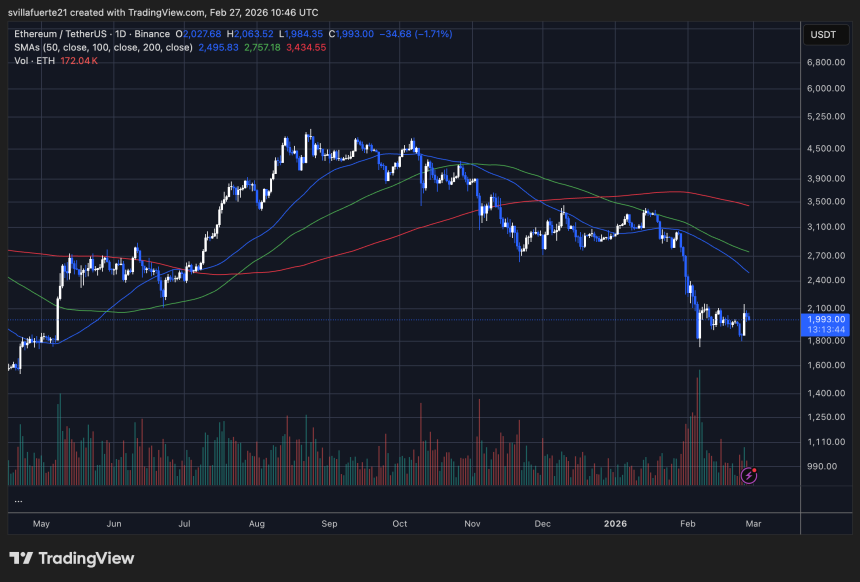
The price is currently below the 50-day, 100-day and 200-day moving averages, all of which are trending down. This alignment confirms bear dynamics in the miniature, medium and long term. It’s worth noting that the 50-day average has declined, reflecting continued selling pressure rather than a fleeting liquidity vacuum.
The acute decline towards the $1,850 zone was accompanied by a significant escalate in volume, suggesting forced liquidations and aggressive distribution. Consolidation volume has since moderated, indicating that while the panic may have abated, buyer confidence remains confined.
Technically, $2,000 functions as a psychological return rather than a validated endorsement. A sustained move above the 50-day average would be required to signal improving momentum. Conversely, failure to maintain the current range could reopen downside risk towards deeper liquidity pockets.
Featured image from ChatGPT, chart from TradingView.com
