
The adoption of digital assets in Latin America is evolving, with more users now converting funds to stablecoins than to Bitcoin – a shift that reflects increasing pressure from local economic conditions.
By Bitso 2025 report In terms of cryptocurrency adoption in Latin America, 40% of cryptocurrency purchases in 2025 were U.S. dollar-pegged stablecoins such as Tether’s USDt (USDT) and Circle’s USDC (USDC), while Bitcoin (BTC) accounted for 18%. The report means that for the first time in the region, stablecoin purchases have exceeded the value of Bitcoin.
The findings are based on data from almost 10 million Bitso retail users on the exchange platform.
The trend reflects a broader move toward what the Latin American cryptocurrency exchange has described as “digital dollarization.” In countries struggling with persistent inflation, currency depreciation and circumscribed access to conventional banking, stablecoins offer a relatively accessible way to store value and transact in US dollar equivalents.
While the US dollar itself is not immune to inflation, it tends to depreciate slower than many local currencies and remains the world’s dominant medium of exchange, making it an attractive benchmark for users seeking stability.
The most purchased assets in 2025 in Latin America. source: Bitso
The global stablecoin market has grown to approximately $320 billion, and its popularity is growing in both developed and emerging economies. Their regional appeal in Latin America is particularly practical: users rely on stablecoins to save, make payments and send cross-border remittances.
The operate of domestic stablecoins benefits from the expansion. Brazilian retail giant Mercado Libre in early April launched a cross-border remittance product using the dollar stablecoin Meli for users in Brazil, Mexico and Chile, according to Cointelegraph Brasil. This comes after the retailer stopped issuing its own stablecoin, Mercado Coin, earlier this year.
Related: Visa adds support for Polygon, Base as stablecoin settlement rate reaches $7 billion
Bitcoin remains the dominant carrier of value
Although the share of Bitcoin purchases in total activity has declined, Bitso’s report shows that the asset still plays a key role as a long-term savings tool in Latin America.
“Bitcoin continues to function as the primary long-term digital store of value in Latin America,” the report said, noting that in 2025 the cryptocurrency is held in 52% of cryptocurrency wallets across the region. This is only slightly down from 53% the previous year.
Bitcoin has long been seen as a store of value despite periods of volatility and uneven performance compared to previous market cycles. The asset rose above $126,000 in October before falling sharply, with prices later reaching a low of $60,000.
Last tests by index developer MarketVector shifts the store of value narrative beyond price performance alone, arguing that Bitcoin and gold share fundamental characteristics, including scarcity, decentralization, and resistance to supply expansion, that underpin their long-term value.
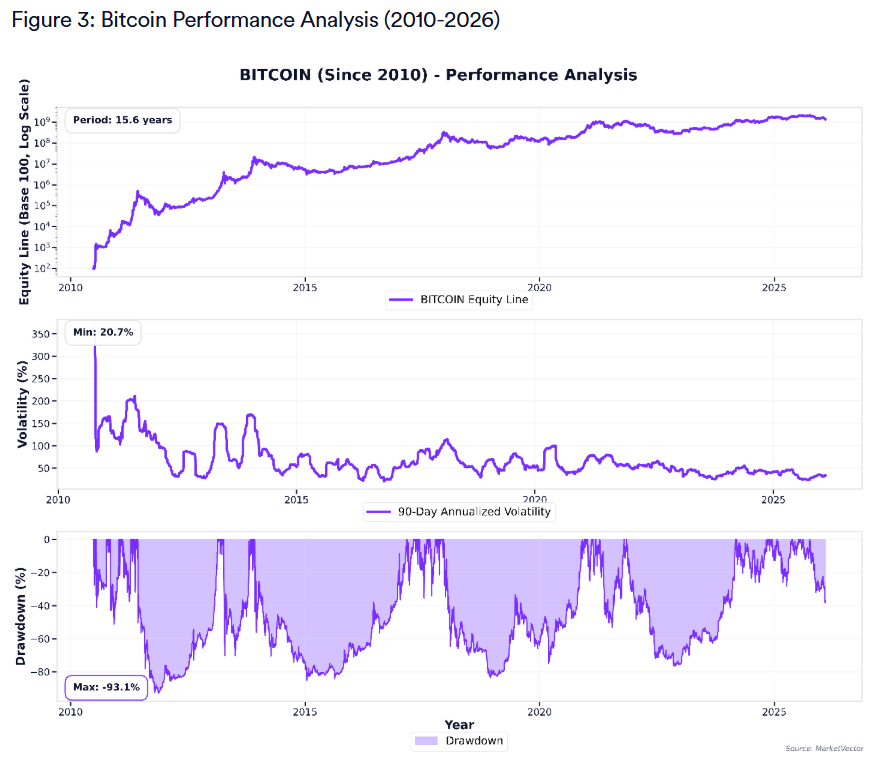
Comparison of Bitcoin’s price performance, volatility and declines since its inception. Source: MarketVector Indices
Related: Has Bitcoin bottomed out versus gold? If history repeats itself, the BTC price will reach 167,000. dollars in 2027
