
According to the data, the second quarter of 2026 has already become the most hacked quarter in history in terms of the number of incidents, with 83 exploits targeting cryptocurrency protocols. analysis by the Unfolded market intelligence platform based on DefiLlama data.
However, the total of $755.3 million stolen so far this quarter is significantly lower than the $3.56 billion lost in the fourth quarter of 2020, which remains the costliest quarter on record for cryptocurrency hacks.
The largest incidents in the quarter were the $293 million KelpDAO hack and the $280 million Drift Protocol exploit.
The numbers suggest that hacking activity is becoming more constant, even as total losses remain below previous record levels.
Crypto Hacks by Monthly Total, All Time Chart. Source: DefiLlama
Bridge exploits emerged as the main attack vector in Q2 2026
The largest attack vector this quarter was cross-chain bridge exploits, with $351 million worth of bridge compromises.
The LayerZero OFT bridge exploit that led to the $293 million KelpDAO breach accounted for more than 38% of the value stolen during the quarter. Attacks on administrators and price manipulation of fraudulent tokens accounted for 37% of the losses, while private key security breaches accounted for 5.66%.
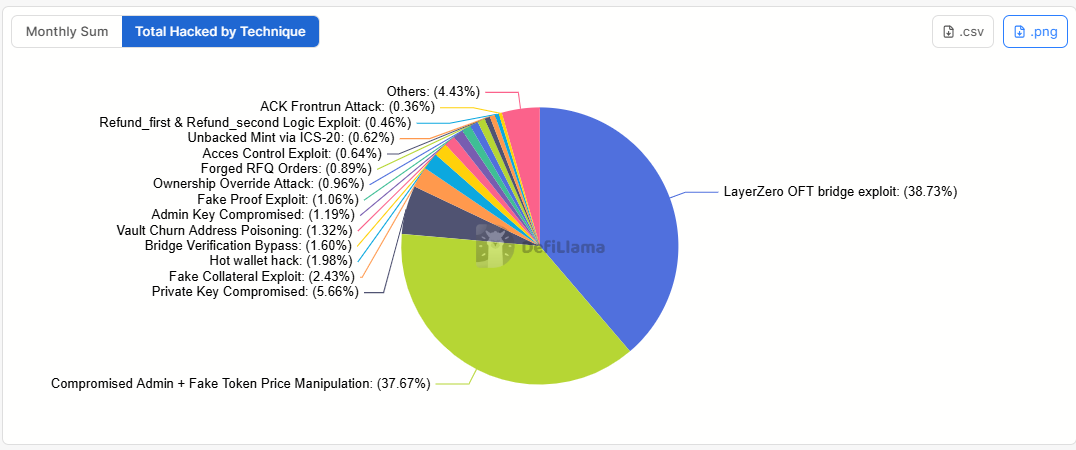
Total hacked by technique in the second quarter of 2026. Source: DefiLlama
Ethereum’s Layer 2 blockchain Taiko is the latest network to experience an exploit in one of the bridge’s protocols, as hackers stole $1.7 million by compromising Taiko’s chain health verification mechanism.
Related: Humanity Protocol’s $36 Million Loss Related to Suspected North Korean Hackers: Quantstamp
Other notable incidents that occurred in the last quarter included the theft of $36 million from Humanity Protocol on June 8 and a $10.7 million exploit on THORChain on May 15.
Other recent incidents include two exploits in abandoned Aztec Connect intelligent contracts, which each resulted in the theft of $2.1 million and $1.3 million from the decentralized exchange Raydium in early June.
These incidents add to the ongoing debate over whether the development of modern artificial intelligence models has changed the security landscape of the crypto industry, following a series of exploits in April.
During a recent interview, Mitchell Amador, CEO of bug bounty platform Immunefi, told Cointelegraph that the proliferation of modern AI models has changed the cybersecurity playing field in attackers’ favor, causing a “vulnerability apocalypse” that has led to a renewed surge in exploits.
Warehouse: Coinbase hack shows the law probably won’t protect you – here’s why
