
Gold (XAU/USD) is making a comeback, rising over 1.20% on Thursday after rebounding from two-month lows near $4,366 as market sentiment improves amid speculation about a US-Iran peace deal. At the time of writing, the XAU/USD rate was $4,500.
XAU/USD jumps as ceasefire hopes offset scorching PCE inflation
Axios reported that Washington and Tehran have reached a peace agreement extending the ceasefire by 60 days as both sides seek to discuss an agreement on Iran’s uranium enrichment program. The news outlet cited two U.S. officials and a regional mediator, although the deal requires approval from U.S. President Donald Trump and senior Iranian officials.
Notably, this news broke after a minor escalation as the United States and Iran exchanged fire, with the latter launching attacks on Kuwait.
The US dollar index (DXY), which measures the dollar’s strength against other currencies, fell 0.19% to 98.97 as risk appetite improved.
On the data side, the core PCE price index, the Federal Reserve’s (Fed) preferred inflation gauge, rose 3.3% y/y in April from 3.2% in March, helped by high energy prices. The nominal value of PCE increased, as expected, by 3.8% y/y, compared to March’s 3.5%.
According to the U.S. Bureau of Economic Analysis, the U.S. economy grew slower than expected in the first quarter of 2026, with GDP growing just 1.6%, revised down from the previous estimate of 2%. At the same time, the United States Department of Labor reported that in the week ending May 23, the number of unemployed people rose to 215,000, exceeding the forecast of 211,000.
Following this data, expectations for an interest rate raise by the Federal Reserve in 2026 have been lowered. According to Prime Terminal data, the current chance of a 25 basis point rate raise is 45%.
The Fed’s commentary remained mixed. Fed President from St. Louis Alberto Musalem warned that if inflation does not fall, an raise in interest rates may be necessary. At the same time, New York Fed President John Williams said the policy was appropriate given the outlook.
In the US, investors are waiting for speeches from Federal Reserve officials before entering the blackout period.
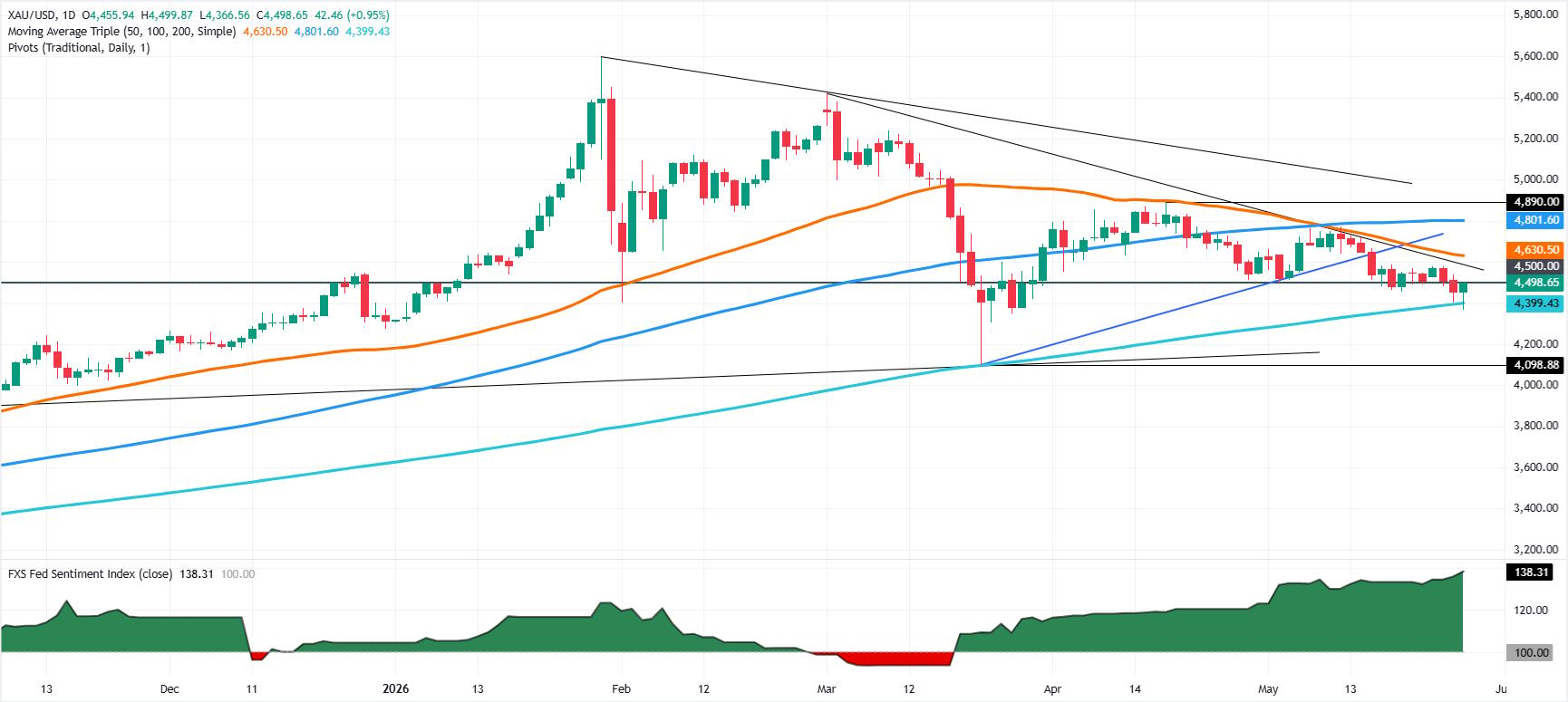
XAU/USD Technical Analysis: Gold price to test key resistance near $4,500
The gold price appears poised to continue its losses, with the yellow metal trading below the resistance trendline established from the March highs that have held over the last nine trading days, meaning sellers are in control.
The Relative Strength Index (RSI) is bearish but shows that further gains are expected in the near future.
If XAU/USD breaks through the psychological level of $4,500, the next stop will be the downtrend resistance trendline near $4,575-4,600. The next stop will be the 50-day straightforward moving average (SMA) at $4,630, before the 100-day SMA at $4,801.
Conversely, if the gold price falls below $4,450, it will open the door to breaking the 200-day SMA at $4,399, followed by the current low of $4,366.
Gold FAQs
Gold has played a key role in human history as it has been widely used as a store of value and a medium of exchange. Nowadays, beyond its luster and operate in jewelry, the precious metal is widely viewed as a safe-haven asset, meaning it is considered a good investment in turbulent times. Gold is also widely seen as a hedge against inflation and currency depreciation because it is not tied to any particular issuer or government.
Central banks are the largest holders of gold. To support their currencies in turbulent times, central banks typically diversify their reserves and purchase gold to improve the perceived strength of the economy and currency. High gold reserves may provide a source of confidence in the country’s solvency. According to data from the World Gold Council, central banks added 1,136 tons of gold to their reserves in 2022, worth about $70 billion. This is the highest annual purchase since registration began. Central banks in emerging economies such as China, India and Turkey are rapidly increasing their gold reserves.
Gold has an inverse correlation with the US dollar and US treasury bonds, which are both major reserve assets and safe and sound haven assets. When the dollar depreciates, gold tends to rise, allowing investors and central banks to diversify their holdings in turbulent times. Gold is also inversely correlated with risky assets. A rally in the stock market tends to weaken the price of gold, while sell-offs in riskier markets support the precious metal.
The price may change due to many factors. Geopolitical instability or fear of a deep recession can quickly cause gold prices to rise due to its safe-haven status. Gold, as a non-yielding asset, tends to rise at lower interest rates, while the higher cost of money tends to weigh on the yellow metal. Still, most of the movements depend on the behavior of the US dollar (USD) when the asset is priced in dollars (XAU/USD). A forceful dollar tends to keep the gold price in check, while a weaker dollar will likely cause gold prices to rise.
