The US Bureau of Economic Analysis (BEA) will release Personal Consumer Expenditures (PCE) price index data for April on Thursday at 12:30 GMT.
The PCE price index is closely watched by market participants because it is the Federal Reserve’s (Fed) preferred measure of inflation and can influence the policy outlook.
Predicting PCE: Insights from the Federal Reserve’s Key Inflation Index
The core PCE Price Index, which excludes volatile food and energy prices, is expected to rise 0.3% month-on-month in April, matching March’s gain.
Over the 12 months ending in April, core PCE inflation will rise to 3.3%. Meanwhile, annual headline PCE inflation is forecast to reach its highest level since May 2023 at 3.8%.
Markets will analyze data on the PCE price index, while Fed officials will take this inflation gauge into account when deciding on their next policy move. Given the uncertainty resulting from the ongoing conflict in the Middle East, investors will review the details of the PCE inflation report to see whether the US central bank will decide to boost interest rates before the end of the year.
According to the CME FedWatch Tool, markets are currently pricing in a roughly 50% probability that the Fed will raise its policy rate by at least 25 basis points by the end of 2026.
In an interview with Reuters on Wednesday, Minneapolis Fed President Neel Kashkari, who dissented at the April policy meeting and voted against including an easing stance in the policy statement, noted that data released since the last meeting showed that inflation risks are higher. Meanwhile, Fed Governor Christopher Waller, known for his dovish views, changed his tone last week and said he should remove the easing bias from the statement. Waller further added that he would not hesitate to support an boost in the policy rate if inflation expectations lose their anchor.
In presenting its PCE inflation report, TD Securities stated:
“We expect core and core PCE prices to decline in April to 0.26% and 0.43% m/m, respectively. Fare carryover was moderate this month, with the slowdown in supercore services offsetting strength in the shelter. Our forecast translates to 3.3% and 3.8% y/y for core and core, respectively. We also expect nominal and real personal spending to decline this month.”
How will the personal consumer spending price index affect EUR/USD?
The US dollar (USD) remains resilient against its rivals this week. Still, it is struggling to gain strength as investors refrain from taking enormous positions due to uncertainty around the conflict between the United States (US) and Iran.
Earlier this week, the United States carried out what it calls “self-defense attacks” on Iranian missile sites and mine-laying ships. In turn, Iran’s Islamic Revolutionary Guard Corps (IRGC) threatened retaliation, calling the US actions a violation of the ceasefire. Nevertheless, the truce officially remains in force, and the parties are reportedly working to finalize a memorandum of understanding (MOU), in particular trying to resolve disputes over language regarding Iran’s nuclear program and sanctions relief.
If the United States and Iran reach an agreement to fully open the Strait of Hormuz, oil prices could plummet and reduce fears that global inflation will spiral out of control. In this scenario, the US dollar may remain under bearish pressure and assist EUR/USD head north, even if PCE inflation data turns out to be higher than analyst estimates.
If the US-Iran issue remains unresolved until inflation data is released, it could have a noticeable impact on the USD valuation. A stronger-than-forecast print in the monthly core PCE price index could strengthen the USD and hurt EUR/USD in the immediate reaction, as it would suggest rising energy costs are increasing price pressures in the broader economy. On the other hand, a gentle print of this data could make it challenging for USD to gain strength and allow EUR/USD to maintain its position.
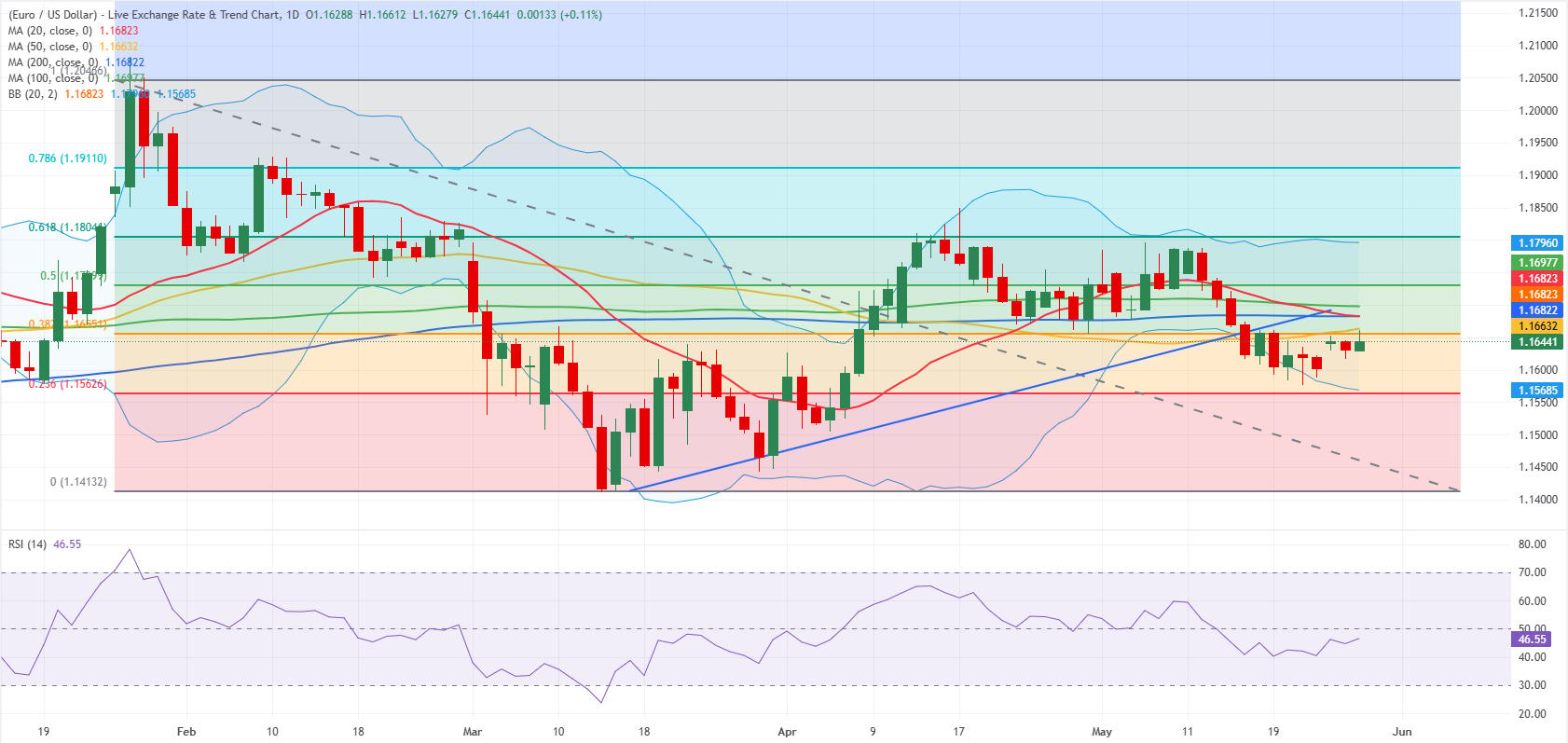
Eren Sengezer, Chief Analyst of the European Session at FXStreet, shares a miniature technical forecast for EUR/USD:
“The short-term technical outlook for EUR/USD is bearish but does not show any momentum growth. The pair remains in the lower half of the Bollinger Bands on the daily chart and is trading below the 20-day, 50-day, 100-day and 200-day simple moving averages (SMAs).”
“On the other hand, the 1.1560 level, where the 23.6% Fibonacci retracement level of the late January to mid-March downtrend meets the lower boundary of the Bollinger Bands, provides key technical support. A daily close below this level could attract technical sellers and open the door to an extended decline towards 1.1400 (static level).”
“Looking north, a robust resistance area appears to have formed around 1.1670-1.1700 (20-day SMA, 100-day SMA, 200-day SMA) before 1.1800 (61.8% Fibonacci retracement, upper bound of Bollinger Bands).