
Gold prices rose more than 1% on Friday as U.S. economic growth slowed, while inflation breached the 3% mark, as shown by the Personal Consumption Expenditures (PCE) price index, the Federal Reserve’s (Fed) favorite inflation gauge. XAU/USD is trading at USD 5,065 after rebounding from daily lows of USD 4,981.
Bullion jumps as US growth slows and core PCE exceeds 3% and stagflation threatens?
Breaking news shows that the US Supreme Court has issued a ruling inconsistent with Trump’s tariffs imposed under the National Emergency Act. This improved risk appetite as US stocks recovered from earlier losses and turned positive during the day. Meanwhile, the US dollar is losing ground, falling 0.11% on the US Dollar Index (DXY).
DXY, which measures the performance of the US currency against six other currencies, is hovering around 97.70.
Meanwhile, US President Donald Trump said the Supreme Court’s decision was disappointing. Nevertheless, he announced that all national security duties under Sections 232 and 301 remain in force. Meanwhile, it added that it would impose 10% global tariffs in addition to other duties under Section 122.
Besides, US economic data showed that the economy is slowing according to the gross domestic product (GDP) data for the fourth quarter of last year, while the price index of basic personal consumption expenditures (PCE) in December increased according to the advanced estimates for the fourth quarter of 2025, falling from 4.4% to 1.4% y/y.
GDP decreased from 4.4% to 1.4% y/y, which is caused by the 43-day suspension of the US government’s activities.
Later, the University of Michigan’s consumer sentiment survey dropped from 57.3 to 56.6 as U.S. households mentioned that “higher prices are hurting their personal finances.” However, annual inflation expectations fell from 4% to 3.4%, while remaining stable at 3.3% over the five-year period.
Meanwhile, US Treasury yields have recovered from earlier losses and are rising, which does not favor the yellow metal. The yield on the 10-year US Treasury bond increased by one basis point to 4.081%.
At the time of writing, money markets have become skeptical about an interest rate cut before June 2026, when Trump nominee Kevin Warsh, if confirmed by the U.S. Congress to become the novel Fed chairman, could choose to cut interest rates.
In the Middle East, the United States is considering whether to target specific Iranian individuals or pursue regime change, according to the Wall Street Journal. Nevertheless, reports indicate that he is considering a constrained attack on Iran, although he favors diplomacy.
Money markets continue to expect two 25-basis-point rate cuts from the Federal Reserve this year, according to data from Prime Market Terminal.
US economic schedule for next week
On the data side, investors will pay attention to the 4-week average of ADP employment changes, jobless claims data and the Producer Price Index (PPI) report for January. Additionally, investors will be paying attention to speeches by Federal Reserve officials and unscheduled press conferences by US President Donald Trump.
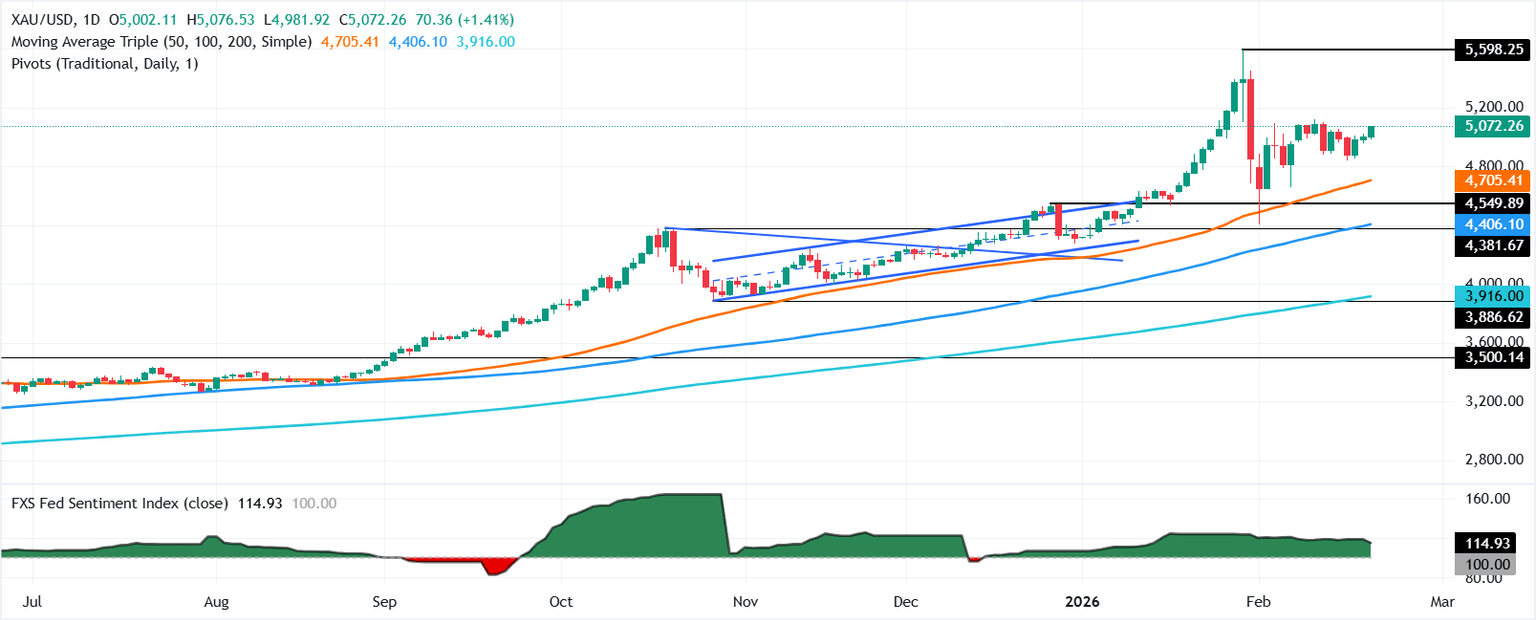
Technical Outlook: Gold Buyers Recover $5,000 in Trade for $5,100 for Further Gains
The technical picture has changed from neutral to bullish, but buyers need to break above the $5,100 threshold to have a chance of driving the yellow metal to test higher prices again. If cleared, the next area of resistance would be the $5,200 level, followed by the January 30 high of $5,451. Overhead costs are at an all-time high at approximately $5,598.
Conversely, if gold holds around $5,000-5,050, it may remain in a swing range as investors wait for further catalysts. However, a drop below the lower end of the range would expose the February 17 intraday low of $4,841, followed by a 50-day plain moving average (SMA) of $4,681.
Gold FAQs
Gold has played a key role in human history as it has been widely used as a store of value and a medium of exchange. Nowadays, beyond its luster and apply in jewelry, the precious metal is widely viewed as a safe-haven asset, meaning it is considered a good investment in turbulent times. Gold is also widely seen as a hedge against inflation and currency depreciation because it is not tied to any particular issuer or government.
Central banks are the largest holders of gold. To support their currencies in turbulent times, central banks typically diversify their reserves and purchase gold to improve the perceived strength of the economy and currency. High gold reserves may provide a source of confidence in the country’s solvency. According to data from the World Gold Council, central banks added 1,136 tons of gold to their reserves in 2022, worth about $70 billion. This is the highest annual purchase since registration began. Central banks in emerging economies such as China, India and Turkey are rapidly increasing their gold reserves.
Gold has an inverse correlation with the US dollar and US treasury bonds, which are both major reserve assets and protected haven assets. When the dollar depreciates, gold tends to rise, allowing investors and central banks to diversify their holdings in turbulent times. Gold is also inversely correlated with risky assets. A rally in the stock market tends to weaken the price of gold, while sell-offs in riskier markets support the precious metal.
The price may change due to many factors. Geopolitical instability or fear of a deep recession can quickly cause gold prices to rise due to its safe-haven status. Gold, as a non-yielding asset, tends to rise at lower interest rates, while the higher cost of money tends to weigh on the yellow metal. Still, most of the movements depend on the behavior of the US dollar (USD) when the asset is priced in dollars (XAU/USD). A mighty dollar tends to keep the gold price in check, while a weaker dollar will likely cause gold prices to rise.
