
Ethereum is holding above the $2,000 level as the market enters a consolidation phase after several days of intense selling pressure that forced prices to plummet. While volatility has declined slightly, sentiment remains volatile as investors assess whether the recent decline represents a momentary correction or the early stage of a broader decline cycle. Against this background, up-to-date on-chain data highlights a remarkable discrepancy between price behavior and network activity.
A recent report from CryptoQuant highlights that the Ethereum network is seeing a significant boost in token transfers even as prices struggle to recover. According to the analysis, as Ethereum corrected from around $3,000 to the $2,000 region, on-chain activity accelerated rather than declined. Specifically, the 14-day rolling average of all tokens transferred increased from approximately 1.6 million on January 29 to approximately 2.75 million on February 7. This is the highest level seen since August 2025.
Such a rapid boost in the volume of transfers during a period of falling prices often signals increased market tension. It may reflect repositioning, forced liquidations or large-scale portfolio adjustments. While not a definitive sign of capitulation on its own, the data suggests that fundamental market dynamics remain tense, making the coming sessions particularly critical for confirming Ethereum’s next direction.
Transfer activity signals stress, not immediate recovery
The report indicates that the recent boost in ERC-20 token transfers reflects heightened stress conditions rather than organic network growth. During keen price declines, increased token movement usually suggests a panic-driven repositioning. Investors often shift from volatile assets to stable coins or move funds to exchanges in preparation for liquidations or defensive portfolio adjustments. This change in behavior tends to boost short-term volatility and strengthen downside dynamics.
Historically, spikes in transfer rates during downturns often coincide with capitulation dynamics. A surge in on-chain activity may signal that weaker market participants are exiting positions under pressure. Such “flush” phases compress sales into a miniature window, allowing the market to absorb excess supply more quickly than during gradual declines.
Some ongoing activity is likely to derive from decentralized financial mechanisms. As the indicator tracks token transfers broadly, some of the boost likely reflects forced liquidations, collateral rebalancing, and automated risk management processes across DeFi lending protocols and derivatives. These cascades can intensify price fluctuations even without up-to-date fundamental catalysts.
The mood seems to be dominated by caution. Historically, when token transfer activity spiked during downtrends, it sometimes preceded stabilization phases. While not a definitive bottom signal, this pattern often suggests that intense selling pressure may be nearing exhaustion.
Ethereum tests key support as momentum weakens
Ethereum’s weekly chart shows continued downward pressure after failing to hold the $3,000 region, with the price currently hovering just above the $2,000 level. This zone has become a critical psychological and structural support, especially as recent candles reflect increasing volatility and keen rejection from higher levels. The market appears to be moving from a correction to a broader consolidation phase, although downside risks remain clear.
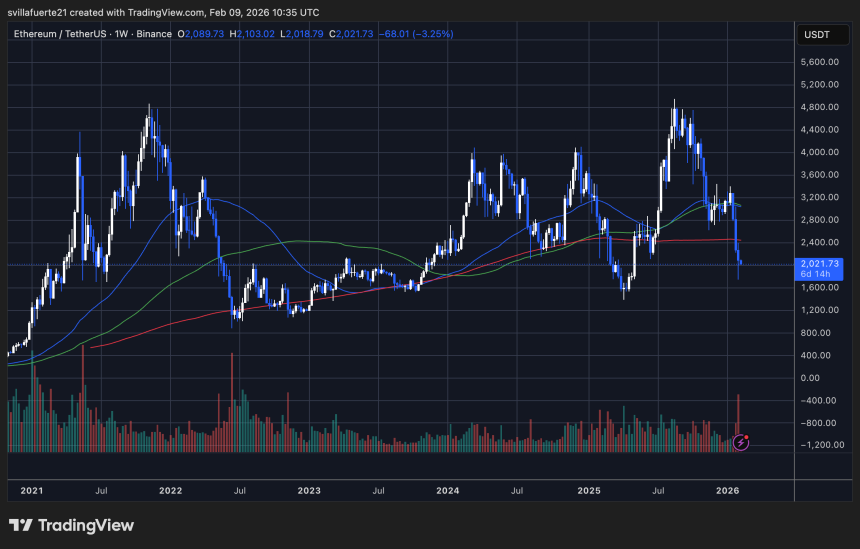
Technically, ETH is trading below the major moving averages, with the short-term averages trending lower and starting to break above the major moving averages. This setup usually signals weakening momentum and suggests that buyers have not yet regained control. The 200-week moving average, currently near the mid-$2,000 range, could act as a key benchmark. Maintaining prices below this value would likely strengthen bearish sentiment.
Recent spikes in sales volume correspond to rapid price declines, indicating distribution rather than accumulation. Historically, such increases in volume during downtrends have often preceded the capitulation of lows or extended sideways consolidation.
From a structural perspective, reclaiming the $2,400-$2,600 range would be necessary to stabilize momentum. Conversely, a decisive break below $2,000 could expose lower historical support zones, potentially accelerating volatility as leveraged positions continue to decline.
Featured image from ChatGPT, chart from TradingView.com
