
Ethereum has come under intense selling pressure, seeing a acute decline of 28% since last Friday as the price firmly lost its psychological level of $3,000. What initially appeared to be a controlled pullback quickly turned into one of the most aggressive downside moves seen in recent months, reflecting a sudden shift in market sentiment and risk appetite across the cryptocurrency space.
On January 31, the Ethereum market experienced a major capitulation event. ETH fell from over $3,000 to the $2,350 zone in a matter of hours, marking one of the steepest single-day corrections this cycle. The speed and scale of this move suggest a forced sale rather than an organized distribution. As the price fell, a dense cluster of stop-loss and liquidation orders were triggered, amplifying the downward momentum and overwhelming liquidity on the offer side.
This quick collapse almost immediately erased weeks of bullish positioning. Traders who set up for a continuation above $3,000 were caught offside. This is leading to a broad reset in derivatives exposure and sentiment. The psychological impact of a loss at such a widely observed level further intensified the sell-off, reinforcing risk-taking behavior in both the cash and futures markets.
As Ethereum stabilizes below previous support, investors are reassessing whether the move represents a transient breakdown or the early stage of a deeper corrective phase. The coming sessions will be crucial in determining whether demand can reemerge after this acute reset.
Cryptoquantum analyst explains that the latest network data confirms that Ethereum’s sell-off was driven by market-wide leverage and not organic spot distribution. According to the Ethereum Long Liquidations (All Exchanges) chart, the total long position liquidated rose to approximately $485 million, marking the second-largest liquidation event since October 10.
These spikes force a reset in the derivatives market by rapidly unwinding overleveraged positions after an extended period of risk build-up.
However, a closer look reveals an crucial discrepancy. Comparing global liquidations data to the Binance chart (All symbols), Binance only saw around $40 million in long liquidations during the same move. This means that Binance accounted for less than 10% of all global liquidations. Despite this being one of the largest derivatives markets in terms of volume. This imbalance indicates that other exchanges have concentrated excessive leverage and aggressive risk-taking, resulting in much more severe liquidation cascades.
This discrepancy means that traders on Binance were either overextending themselves less or employing more stringent risk management. Enabling them to resist a acute downward move more effectively. In contrast, other platforms bore the brunt of forced deleveraging.
From a broader perspective, this type of long squeeze tends to remove excess speculation. While painful for bullish positioning, it often sets the stage for stabilization as the market seeks a novel balance. Monitoring open interest and funding rates outside of Binance will be crucial as the main drivers of volatility clearly originate outside the Binance ecosystem.
Ethereum’s price structure has deteriorated rapidly, and the chart shows how decisively the market has gone into bear mode. After repeatedly failing to reclaim the $3,000-$3,200 zone, ETH has broken down aggressively, breaking through previous support levels with little resistance. The recent move below $2,400 represents a clear expansion of the downtrend, not a controlled pullback.
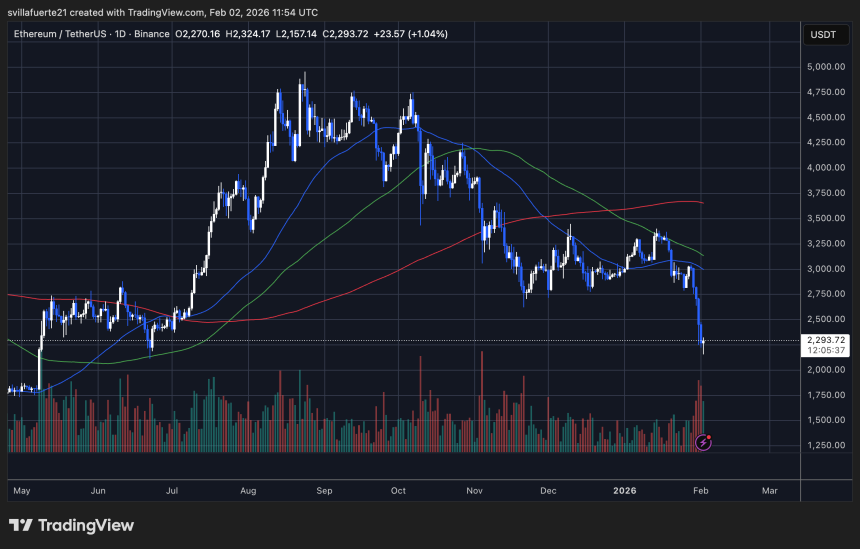
From a trend perspective, ETH is trading well below the tiny and medium term moving averages, with the 50-day and 100-day MAs currently acting as vigorous resistance. The falling slope of these averages increases the likelihood that sellers will pursue rallies rather than extend them. The 200-day moving average, being significantly higher, confirms that the broader structure has moved away from the uptrend.
The behavior of volume adds another level of concern. The selloff near $2,300 was accompanied by increased volume, which signaled forced selling and surrender rather than organic distribution. This trend is consistent with the latest liquidation data and indicates that the market has been aggressively flushing out leverage.
In the tiny term, the critical area to watch is the $2,300-$2,200 zone. It is the first significant support after the breakdown. Lack of stabilization in this area would open the way to deeper retreats. The chart suggests that the path of least resistance remains down.
Featured image from ChatGPT, chart from TradingView.com
