
XRP fell below the $1.90 level amid increasing selling pressure in the market, reinforcing the cautious tone of recent price action. Attempts at short-term stabilization have so far failed and momentum remains volatile as investors respond to weakening structure rather than clear directional signals. A drop below $1.90 puts XRP back in a zone where the risk of suffering a loss is being reassessed, especially in the absence of mighty demand for a rebound.
A recent report by CryptoQuant provides context for this behavior, pointing to a market that is stuck in what it calls a state of cautious equilibrium. According to Binance data, XRP is currently trading around $1.89, while its 200-day moving average is hovering around $2.54. This leaves the price approximately 25% below the long-term benchmark trend, a gap that clearly signals continued structural weakness rather than a confirmed recovery.
Historically, sustained bullish phases have typically developed only after prices have recovered and remained above the 200-day average. XRP’s continued distance from this level suggests that the market is still operating in a corrective range where gains are being sold rather than extended. While short-term recovery efforts are evident, they are narrow in scope and conviction.
The report explains that XRP’s current price action is best understood through a risk-adjusted lens rather than raw price movement. From this perspective, the 30-day Sharpe ratio is just 0.034, close to zero. This means that returns have barely compensated for the risk taken over the past month, a hallmark of markets that lack clear directional conviction.
These conditions typically signal a consolidation phase in which volatility declines and investors become more selective, making the price increasingly sensitive to changes in liquidity rather than dynamics.
At the same time, the Sharpe Z-Score turned positive at around 0.70, suggesting a relative improvement in return quality compared to XRP’s recent historical average. However, this reading remains well below the threshold typically associated with the formation of a statistically significant trend. In practice, this means that while selling pressure has eased from previous extremes, the market has not yet moved into mighty risk-adjusted performance mode.
Short-term dynamics reinforce this cautious view. The 7-day Sharpe Momentum is near 0.03, reflecting frail but positive momentum. While this keeps the ratio slightly above zero, the low volume indicates gradual base building rather than impulsive purchases.
Taken together, these indicators describe a market in balance – no longer under aggressive pressure, but still lacking the conviction and return profile typically seen at the beginning of sustained uptrends.
XRP remains below key moving averages
XRP price action continues to reflect a situation where the market is stuck in a corrective and defensive phase. On the daily chart, XRP is hovering around $1.87-1.90, failing to sustain recent rebound attempts and remaining well below all major moving averages.
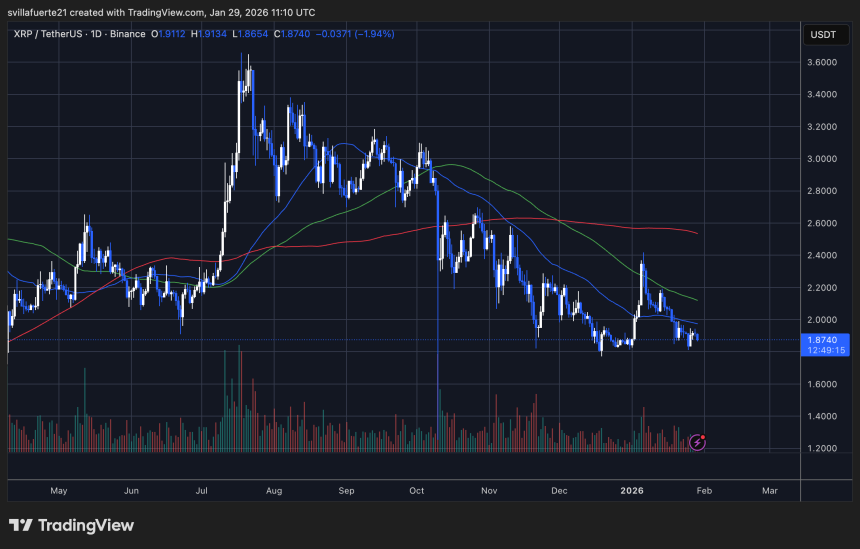
The 50-day moving average (blue) is trending down and acting as vigorous resistance, while the 100-day (green) and 200-day averages (red) remain well above the price, reinforcing the broader bear structure. With XRP trading around 25% below the 200-day MA, the long-term trend has not yet returned to the bullish regime.
Structurally, the chart shows a clear sequence of lower highs and lows since the October crash, confirming continued selling pressure. The piercing vertical decline in early October marked a decisive change in trend, with the price then consolidating in a decreasing range rather than forming a reversal base. Recent attempts to recover the $2.10-$2.20 amount quickly failed. Suggesting indigent follow-up from buyers.
Selling spikes during down moves are more observable than buying volumes during bounces, indicating a defensive position rather than accumulation.
As long as XRP remains below the 50-day limit and fails to reclaim the $2.20-$2.30 zone, price behavior is more consistent with distribution and consolidation rather than a trend reversal.
Featured image from ChatGPT, chart from TradingView.com
