
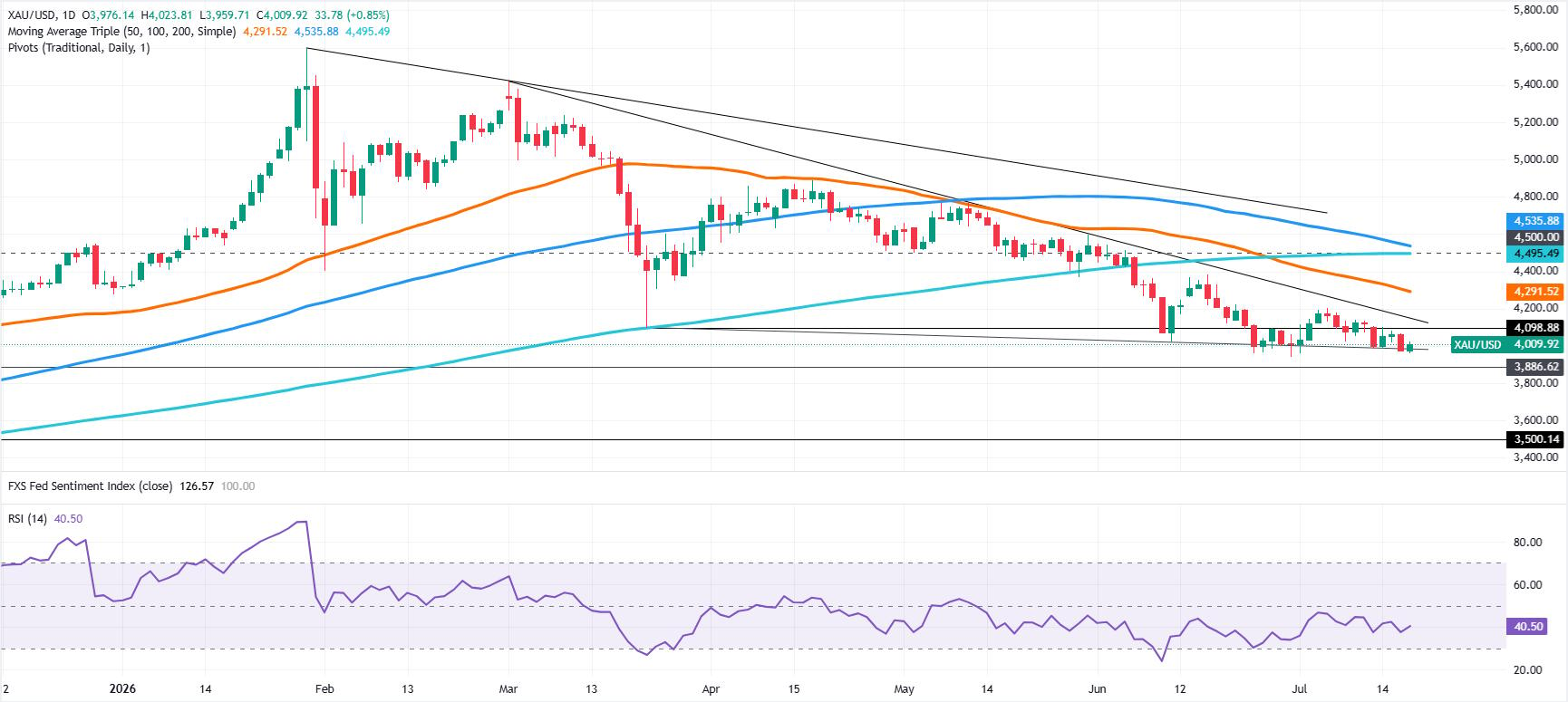
Gold rose about 0.92% on Friday as the U.S.-Iran conflict raised energy prices, ultimately leading to higher inflation, raising expectations that the Federal Reserve (Fed) will have to raise interest rates. At the time of writing, XAU/USD is trading at $4,013, having hit an intraday low of $3,959.
XAU/USD rises as escalation in the Middle East revives inflation fears
The attacks between the US and Iran worsened market sentiment despite the ongoing recovery in US stock markets. Newswire revealing further escalation of war is pushing the volatile metal higher.
Axios reported that the Trump administration is sending dozens of additional refueling planes to Israel in preparation for a potential expansion of military operations.
On the data side, consumer sentiment at the University of Michigan improved in July. From 50.7 to 54, it results from lower gasoline prices at gas stations, according to the report. Inflation expectations over one year fell from 4.6% in June to 4.2% and remained stable at 3.3% over five years.
In addition, Cleveland Fed President Beth Hammack expressed a hawkish stance and expressed concern about persistently high inflation, which is at the top of her list, adding that “inflation is too high.” Hammack added that the labor market is solid and that “economic growth data is good and consumer spending is stable.”
On Thursday, Fed Vice Chairman Philip Jefferson said he was open to raising interest rates if there was no progress toward disinflation.
Based on Prime Terminal data, money markets estimated the likelihood of a Fed rate hike at its Oct. 28 meeting at almost 61%. The central bank is expected to keep interest rates steady at its July meeting with a 76% probability.
Next week’s U.S. economic report will include employment data and S&P Global’s flash PMIs as Fed officials enter a blackout period ahead of the July 29 policy meeting.
XAU/USD Technical Outlook: Gold Recovers but Remains Bearish
Gold price is bearish as the downtrend continues, even as XAU regained the $4,000 mark after rebounding from $3,959. Nevertheless, momentum remains negative as the Relative Strength Index (RSI) falls below its 50-neutral level. This signals that the XAU/USD currency pair is likely to decline further unless buyers overcome key technical resistance levels.
In the case of a bearish continuation, the first support is the psychological level of $4,000. Below this level is the intraday low at $3,959, ahead of the $3,900 level. A breach of the latter will result in the discovery of the October 28, 2025 low of $3,886.
Conversely, for a bullish reversal to occur, Bullion must break the downtrend resistance line between $4,125 and $4,175. Above this area, a potential test of the 50-day elementary moving average (SMA) at $4,291 is projected. In addition, the next hurdle is the 200-day SMA at $4,495, which if breached could open the way to $4,500.
Gold FAQs
Gold has played a key role in human history as it has been widely used as a store of value and a medium of exchange. Nowadays, beyond its luster and exploit in jewelry, the precious metal is widely viewed as a safe-haven asset, meaning it is considered a good investment in turbulent times. Gold is also widely seen as a hedge against inflation and currency depreciation because it is not tied to any particular issuer or government.
Central banks are the largest holders of gold. To support their currencies in turbulent times, central banks typically diversify their reserves and purchase gold to improve the perceived strength of the economy and currency. High gold reserves may provide a source of confidence in the country’s solvency. According to data from the World Gold Council, central banks added 1,136 tons of gold to their reserves in 2022, worth about $70 billion. This is the highest annual purchase since registration began. Central banks in emerging economies such as China, India and Turkey are rapidly increasing their gold reserves.
Gold has an inverse correlation with the US dollar and US treasury bonds, which are both major reserve assets and sheltered haven assets. When the dollar depreciates, gold tends to rise, allowing investors and central banks to diversify their holdings in turbulent times. Gold is also inversely correlated with risky assets. A rally in the stock market tends to weaken the price of gold, while sell-offs in riskier markets support the precious metal.
The price may change due to many factors. Geopolitical instability or fear of a deep recession can quickly cause gold prices to rise due to its safe-haven status. Gold, as a non-yielding asset, tends to rise at lower interest rates, while the higher cost of money tends to weigh on the yellow metal. Still, most of the movements depend on the behavior of the US dollar (USD) when the asset is priced in dollars (XAU/USD). A mighty dollar tends to keep the gold price in check, while a weaker dollar will likely cause gold prices to rise.
