
Gold prices rose sharply on Thursday after U.S. President Donald Trump revealed that the United States and Iran were close to agreeing on a deal, weakening the U.S. dollar and strengthening the yellow metal, recouping some of Wednesday’s losses. The XAU/USD rate is USD 4,212, up 3.50%
XAU/USD rebounds sharply as dollar falls on diplomatic breakthrough
US President Donald Trump recently said that the United States and Iran could sign an agreement as early as the weekend, which would allow traffic to open through the Strait of Hormuz. Iran-affiliated news agency FARS revealed that “it appears that given that the United States has accepted the text proposed by Iran, the likelihood of this text being approved by the main authorities of the system is high.”
Meanwhile, the U.S. Dollar Index (DXY), which tracks the dollar’s value against a basket of currencies, fell 0.42% to 99.66, representing a good run for the underperforming metal.
Inflation data in the US showed that prices of agricultural products increased by 6.5% y/y in May, which was higher than April’s 5.7% and the forecasted 6.4%. The core producer price index (PPI), excluding energy and food, increased by 4.9% y/y, below the consensus of 5.4% and unchanged from April.
It is worth noting that today’s PPI report, along with the CPI released a day ago, maintained investors’ expectations for an interest rate augment by the Federal Reserve at the end of 2026, according to Prime Terminal data.
The U.S. economic schedule also included employment data, as jobless claims rose by 229,000 in the week ending June 6, exceeding 219,000. expected by analysts.
In the coming week, the US economic report will include the release of the University of Michigan’s preliminary reading of consumer sentiment for June, ahead of the Federal Reserve’s monetary policy
XAU/USD Technical Outlook: Gold Price Surpasses $4,200 Amid US-Iran War Deal
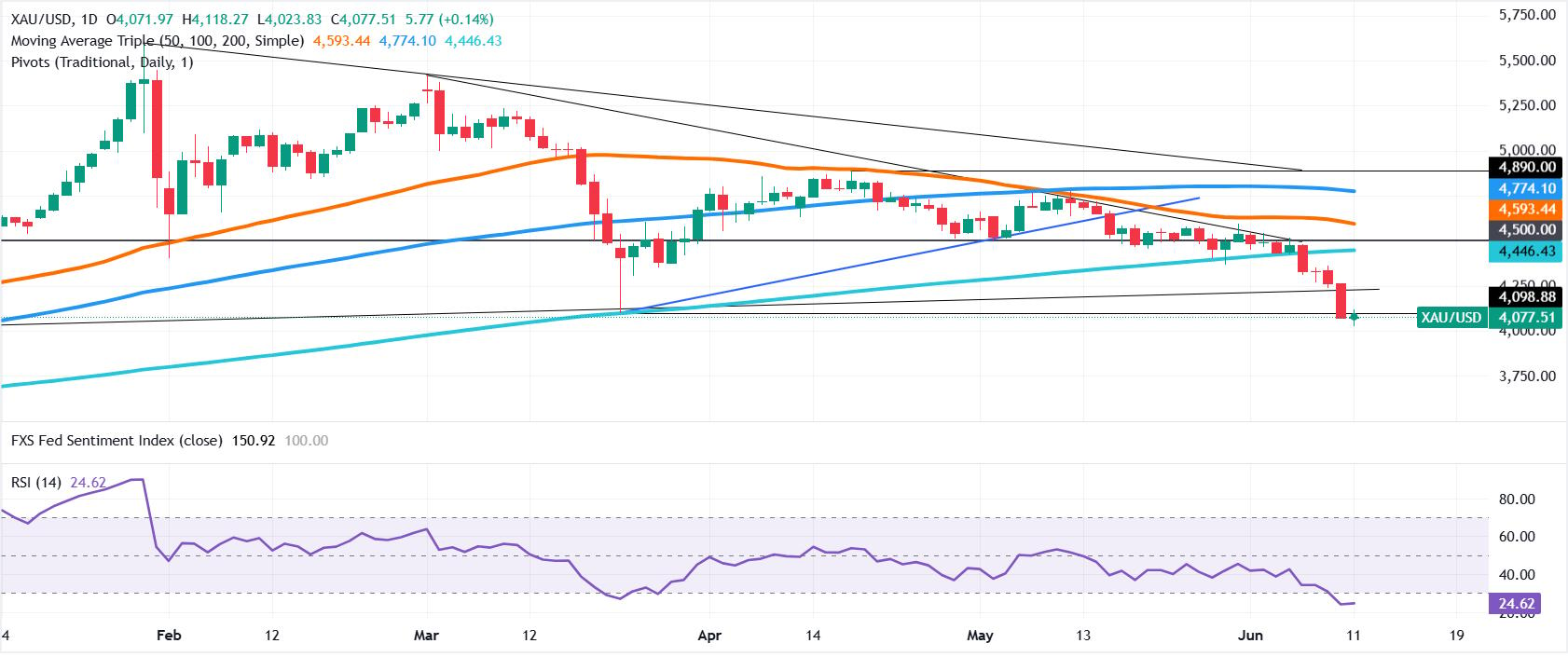
Gold fell after hitting a six-month low of $4,023, with sellers pushing the price below the previous low of $4,098, paving the way for further declines. Momentum favors further decline as indicated by the Relative Strength Index (RSI) which is oversold but does not reach the most extreme level below the 20 area. The downtrend therefore remains unchanged and further losses are expected.
If bullion prices fall below $4,000, the next significant level of support from supply and demand dynamics will be the October 28, 2025 level, which will hit a low of $3,886.
On the upside, XAU/USD needs to reclaim the 200-day basic moving average (SMA) at $4,443, paving the way for a test of $4,500.
Gold FAQs
Gold has played a key role in human history as it has been widely used as a store of value and a medium of exchange. Nowadays, beyond its luster and apply in jewelry, the precious metal is widely viewed as a safe-haven asset, meaning it is considered a good investment in turbulent times. Gold is also widely seen as a hedge against inflation and currency depreciation because it is not tied to any particular issuer or government.
Central banks are the largest holders of gold. To support their currencies in turbulent times, central banks typically diversify their reserves and purchase gold to improve the perceived strength of the economy and currency. High gold reserves may provide a source of confidence in the country’s solvency. According to data from the World Gold Council, central banks added 1,136 tons of gold to their reserves in 2022, worth about $70 billion. This is the highest annual purchase since registration began. Central banks in emerging economies such as China, India and Turkey are rapidly increasing their gold reserves.
Gold has an inverse correlation with the US dollar and US treasury bonds, which are both major reserve assets and sheltered haven assets. When the dollar depreciates, gold tends to rise, allowing investors and central banks to diversify their holdings in turbulent times. Gold is also inversely correlated with risky assets. A rally in the stock market tends to weaken the price of gold, while sell-offs in riskier markets favor the precious metal.
The price may vary due to many factors. Geopolitical instability or fear of a deep recession can quickly cause gold prices to rise due to its safe-haven status. Gold, as a non-yielding asset, tends to rise in lower interest rates, while the higher cost of money tends to weigh on the yellow metal. Still, most of the movements depend on the behavior of the US dollar (USD) when the asset is priced in dollars (XAU/USD). A powerful dollar tends to keep the gold price in check, while a weaker dollar will likely cause gold prices to rise.
