
Bitcoin continues to struggle to regain the $70,000 level, with continued selling pressure keeping the market on the defensive. Price action has repeatedly failed to deliver sustained momentum above this psychological threshold, reflecting cautious sentiment among both institutional and retail participants. While volatility has moderated from the steep declines seen earlier in the cycle, the broader pattern still suggests the market is seeking direction rather than entering a clear recovery.
The latest on-chain data from analyst CryptoQuant offers additional context by examining the location of the whales. Wallets ranging from 1,000 to 10,000 BTC currently control approximately 4.483 million BTC as of February 16, 2026. This cohort is dominated by long-term coin holding whales – those who hold coins for more than 155 days – with approximately 3.196 million BTC, or approximately 71.3% of the total. Short-term whales, defined as holding periods of less than 155 days, account for approximately 1.287 million BTC, or 28.7%.
While newer whale balances have increased slightly in recent months, structural control remains in the hands of long-term holders. This imbalance suggests that while newer capital is under continued pressure, more established investors continue to anchor the market. It remains an open question whether these dynamics promote stabilization or precede further volatility.
Whale cost base signals redistribution rather than surrender
The analyst emphasizes that the most decisive signal comes from comparing the realized price – the average acquisition cost in the chain – for different cohorts of whales. The price for short-term (STH) whales is currently close to $88,494, while long-term (LTH) whales maintain a much lower cost base of around $41,626. With Bitcoin trading near $68,795, the contrast is stark. Newer whales have approximately 22% unrealized losses, while long-term whales retain an estimated profit margin of 65%.
This asymmetry highlights a familiar market active: Newest capital comes under pressure while structurally entrenched holders continue to operate from a position of strength. When price declines accelerate, historically speaking, short-term whales are the first to capitulate, locking in losses. The latest data on realized gains suggests that this process has already intensified since Bitcoin’s October all-time high, with deeper negative spikes emerging as the correction progresses.
Historically, similar configurations observed in 2019 and 2022 corresponded to phases of redistribution, not systemic breakdown. The supply gradually shifted from less confident participants towards stronger holders. The key threshold remains the realized LTH price around PLN 41.6 thousand. dollars. As long as Bitcoin is trading above this level, structural capitulation will not be confirmed. Instead, the current phase appears to reflect the transfer of convictions rather than widespread market destruction.
Bitcoin’s price action on a 3-day time horizon continues to reflect a structurally frail market following a acute rejection from slow 2025 highs near $125,000. BTC has since printed a sequence of lower highs and lower lows, confirming a clear intermediate downtrend. The recent decline towards the $65,000-$70,000 zone highlights continued selling pressure, especially after repeated failures to reclaim higher moving averages.
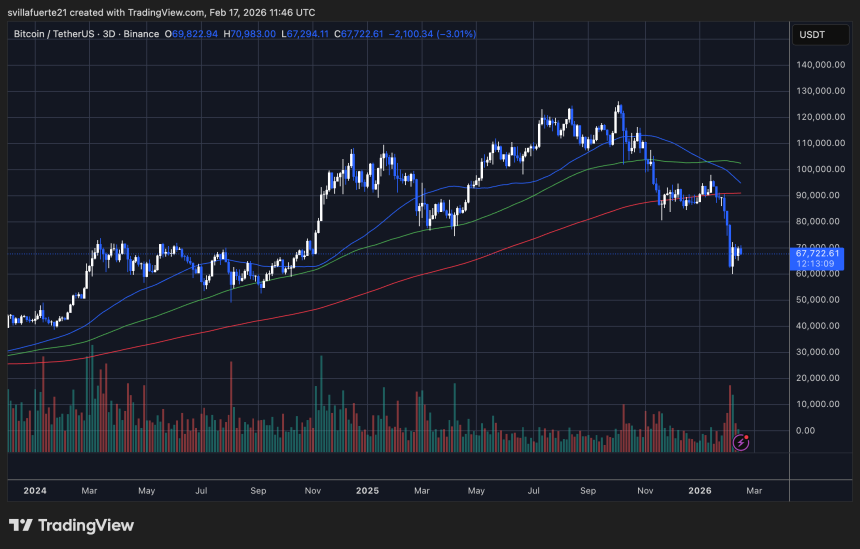
From a technical perspective, the price is currently below the 50-, 100- and 200-period moving averages, all of which are starting to decline. This setting typically signals bearish momentum and suggests that gains may continue to face resistance. The region’s 200-period average of $90,000 currently represents a significant structural barrier rather than support.
Volume dynamics reinforce this interpretation. Sales spikes accompanying recent declines appear to be stronger than purchasing activity during rebounds, indicating distribution rather than accumulation in the compact term. However, stabilization near the $65,000-$70,000 range suggests a potential consolidation phase rather than an immediate continuation of declines.
Key support is located around the recent local low near $60,000. A sustained break below this level could trigger another spike in volatility, while a rebound above $80,000 would be necessary to neutralize the current bearish structure and shift sentiment toward stability.
Featured image from ChatGPT, chart from TradingView.com
