
The Bank of Japan (BoJ) is expected to leave its benchmark interest rate unchanged at 0.75% at the end of its two-day monetary policy meeting next Friday.
Japan’s central bank raised interest rates to the highest level in three decades in December and will likely be in a better position to assess the economic consequences of previous rate increases on Friday.
BOJ Governor Kazuo Ueda is expected to maintain the bank’s commitment to further monetary policy normalization. In this sense, investors will be analyzing Ueda’s press conference with particular attention to gain better insight into the timing and scope of the bank’s tightening cycle.
What can you expect from the BoJ’s interest rate decision?
The BOJ is widely expected to leave interest rates unchanged in January and signal further tightening of monetary policy if the economic situation develops in line with the bank’s projections.
In December, the bank’s monetary policy committee approved a 25-basis-point enhance in interest rates to the current level of 0.75%, and the minutes of the meeting revealed that some policymakers see the need to tighten monetary policy further as real interest rates remain deeply negative, taking inflation into account.
However, another enhance in interest rates is completely rejected by the market. Even more so after Prime Minister Sanae Takaichi’s unexpected call for early elections earlier this week and her plans to suspend taxes on food and beverages for two years to assist households cope with rising inflation trends.
It is still unclear what impact these actions will have on the central bank’s monetary policy, but the BOJ plans to gradually normalize its monetary policy and withdraw monetary stimulus measures without harming economic growth. In this situation, the bank will decide to wait until the political scenario is clarified and the consequences of previous interest rate increases become clear before it starts tightening monetary policy further.
In turn, the yen has been systematically losing value since speculation about early elections appeared on the market. It will be intriguing to see whether the weakening yen has prompted the central bank to adopt a less ambivalent stance towards tightening monetary policy.
How might the Bank of Japan’s monetary policy decision affect USD/JPY?
Investors are fully pricing in the BOJ’s interest rate freeze on Friday, but the bank will need to make a clear commitment to a further tightening cycle to stem the current yen depreciation.
The yen bears have taken a breather over the past few days, helped by the widespread weakening of the US dollar amid a trade rift between the European Union (EU) and the United States following President Donald Trump’s threats to annex Greenland. USD/JPY, however, remains around 0.7% on the year and is relatively close to the 18-month high near 159.50 reached last week.
Investors fear that Prime Minister Takaichi could gain more parliamentary support after the election to expand his big-spending, lower-tax policies, increasing pressure on the country’s strained public finances. This has pushed the yen and long-term Japanese yields to record highs amid fears of a looming fiscal crisis.
Recent comments from BOJ Governor Ueda confirmed the bank’s rhetoric regarding a gradual tightening of monetary policy, indicating that Japan is moving towards a more tough inflation regime, with a mechanism of simultaneous wage and price increases introduced. The yen will need clear signs of interest rate increases to prolong the so far feeble recovery.
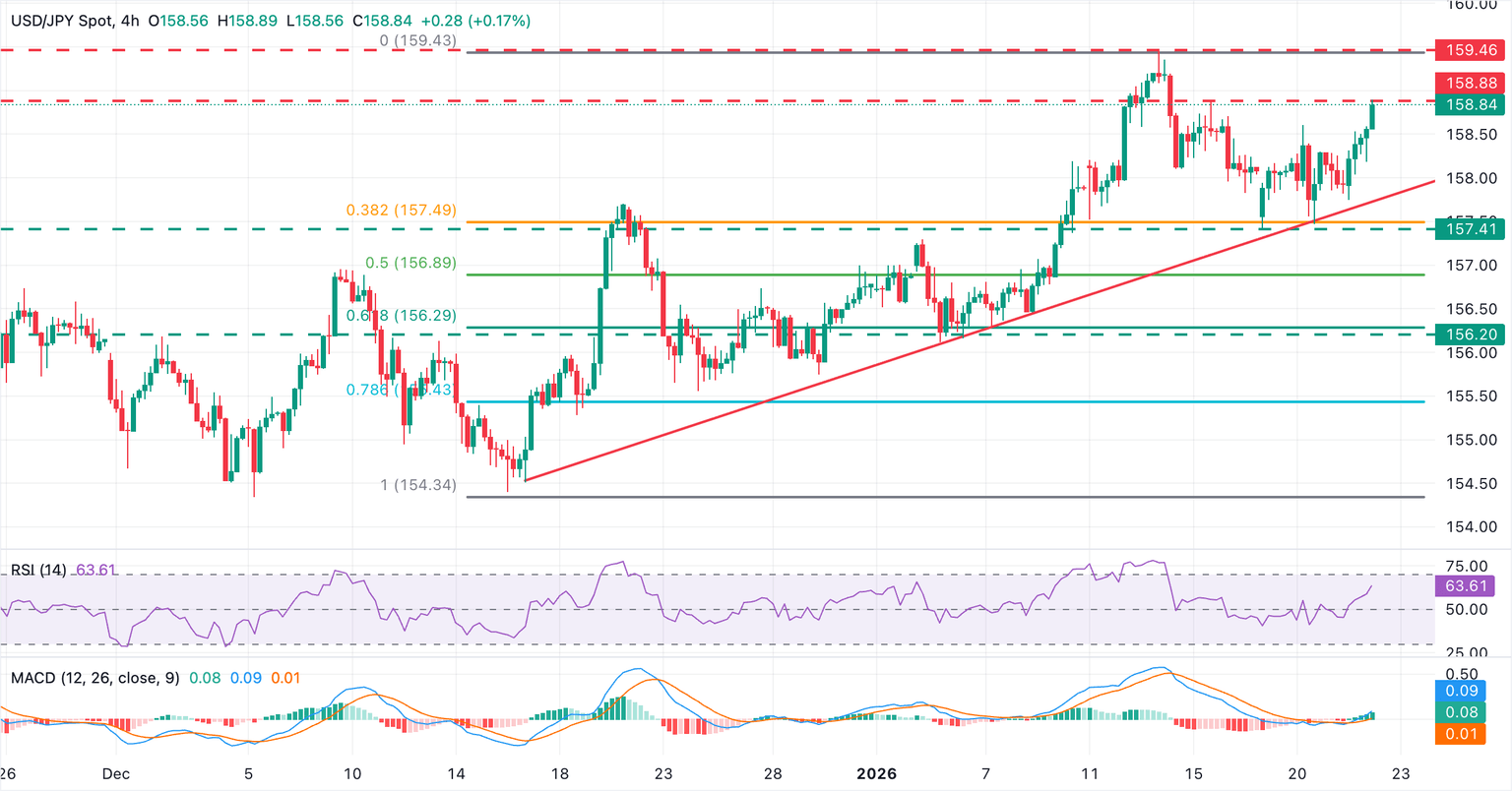
From a technical perspective, FXStreet analyst Guillermo Alcalá sees the USD/JPY pair in a bearish correction phase, with key support above the 157.40 area: “The pair has retreated from the highs, but yen bulls would need to break the support area between 157.40 and 157.60 to cancel the short-term bullish structure and target the early January lows around 156.20″.
An uncertain BoJ announcement would disappoint markets and weaken support for the yen. In that case, Alcalá sees the pair making new long-term highs: “Technical indicators are turning positive. The 4-hour RGI has bounced off the 50 line, highlighting stronger bullish momentum. At the time of writing, the pair is testing resistance at 158.70 (January 16 high), which represents the last barrier before the 18-month high near 159.50.”
Frequently asked questions about the Bank of Japan
The Bank of Japan (BoJ) is Japan’s central bank that sets the country’s monetary policy. Its mandate is to issue banknotes and exercise currency and monetary control to ensure price stability, which means an inflation target of around 2%.
The Bank of Japan began ultra-loose monetary policy in 2013 to stimulate the economy and generate inflation in a low-inflation environment. The bank’s policy is based on quantitative and qualitative easing (QQE), which is printing banknotes to buy assets such as government or corporate bonds to provide liquidity. In 2016, the bank doubled down on its strategy and further loosened its policy, first introducing negative interest rates and then directly controlling the yield on 10-year Treasury bonds. In March 2024, the BoJ raised interest rates, effectively withdrawing from its ultra-loose monetary policy stance.
The Bank’s massive stimulus caused the yen to depreciate against other major currencies. This process intensified in 2022 and 2023 as policy divergences widened between the Bank of Japan and other major central banks, which decided to sharply raise interest rates to combat decades-long levels of inflation. The BoJ’s policy led to a deepening differential against other currencies, which resulted in a decline in the value of the yen. This trend was partially reversed in 2024, when the BoJ decided to abandon its ultra-loose policy stance.
A weaker yen and a pointed enhance in global energy prices led to a rise in inflation in Japan, which exceeded the BoJ’s target of 2%. The prospect of rising wages in the country – a key element driving inflation – also contributed to this move.
Economic indicator
BoJ decision on interest rates
The Bank of Japan (BoJ) announces its decision on interest rates after each of the Bank’s eight scheduled annual meetings. Generally speaking, if the BoJ is hawkish on the economy’s inflation outlook and increases interest rates, it is bullish on the Japanese yen (JPY). Similarly, if the BoJ takes a dovish view of the Japanese economy and keeps interest rates unchanged or lowers them, this is usually negative for the yen.
Read more.
Next release:
Friday 23 January 2026 03:00
Frequency:
Irregular
Agreement:
0.75%
Previous:
0.75%
Source:
Bank of Japan
