
Gold (XAU/USD) suffered losses of more than 0.70% on Friday as traders took profits as US data over the past two weeks showed the labor market was not as faint as expected. Therefore, investors are becoming skeptical that the Federal Reserve (Fed) can decide on two cuts, as swap markets reflect. At the time of writing, the XAU/USD rate is USD 4,580.
Bullion Pulls Back as Resilient U.S. Data and Easing Geopolitical Risks Force Traders to Cut Fed’s Aggressive Monetary Policy Easing Assumptions
Market sentiment is turning negative as US President Donald Trump has shaken markets as he appears reluctant to nominate National Economic Council director Kevin Hassett as Fed chairman. “I actually want to stop you right where you are if you want to know the truth,” Trump told Hassett at a White House event.
In headlines, the US dollar jumped and the price of gold fell to $4,560 before returning to its current price level. Polymarket reported that Kevin Warsh is the favorite to become the next Fed chairman, with his chances increasing from about 40% to 60%.
Meanwhile, geopolitical risk premiums continued to fall as reports emerged that Israeli Prime Minister Benjamin Netanyahu told Trump to halt the attack on Iran. However, according to AXIOS, in the second conversation, Netanyahu asked Trump to refrain from military action to give Israel more time to prepare for potential Iranian retaliation. Additionally, U.S. officials have said that military action is not out of the question if Tehran resumes killing protesters.
Data showed U.S. industrial production rose 0.4% in December, topping estimates of a 0.1% decline, the Federal Reserve revealed.
Fed officials, led by Gov. Michelle Bowman and Boston Fed President Susan Collins, reached an agreement. It is worth noting that policymakers will begin the blackout period on Saturday.
The next data from the US will be released next week
The U.S. schedule will include housing data, jobless claims, the final third-quarter 2025 GDP reading, the Fed’s favorite inflation metrics, the Personal Consumption Expenditures (PCE) price index, flash PMIs and consumer sentiment.
Daily Market Move Summary: Bullion Poised for Minimum Weekly Gains as Dollar Rebounds
- The US Dollar Index (DXY), which tracks the US currency’s performance against six other currencies, rose 0.03% to 99.38. U.S. Treasury yields are soaring after Hassett’s headline, with the 10-year Treasury yield rising nearly five basis points to 4.219%.
- US economic data showed a mixed inflation picture, with consumer prices stabilizing and producer prices rising. Year-over-year, headline CPI remained at 2.7% in December, virtually unchanged from November, while PPI accelerated to 3%, up from 2.8% the previous month, highlighting continued upstream cost pressures.
- The labor market also signaled resilience. Last Friday’s nonfarm payrolls report was solid despite lower-than-expected forecasts, while the unemployment rate fell to 4.4%, below the Fed’s projection of 4.5%. Reinforcing this strength, the number of initial unemployed fell from 207,000 to to 198,000, which indicates fewer Americans are applying for unemployment benefits.
- Fed Governor Michelle Bowman said the central bank should not pause its monetary easing cycle and should cut interest rates again given labor market risks. Boston Fed President Susan Collins praised the central bank’s independence, adding that “a central bank that, while accountable, has the independence required to make difficult decisions that may be unpopular in the short term.”
- In this situation, investors narrow the chances of further easing of monetary policy by the Federal Reserve. Main Square Terminal data shows 43 basis points of easing expected by the end of 2026.
Technical analysis: Gold price drops below $4,600, we expect $4,550
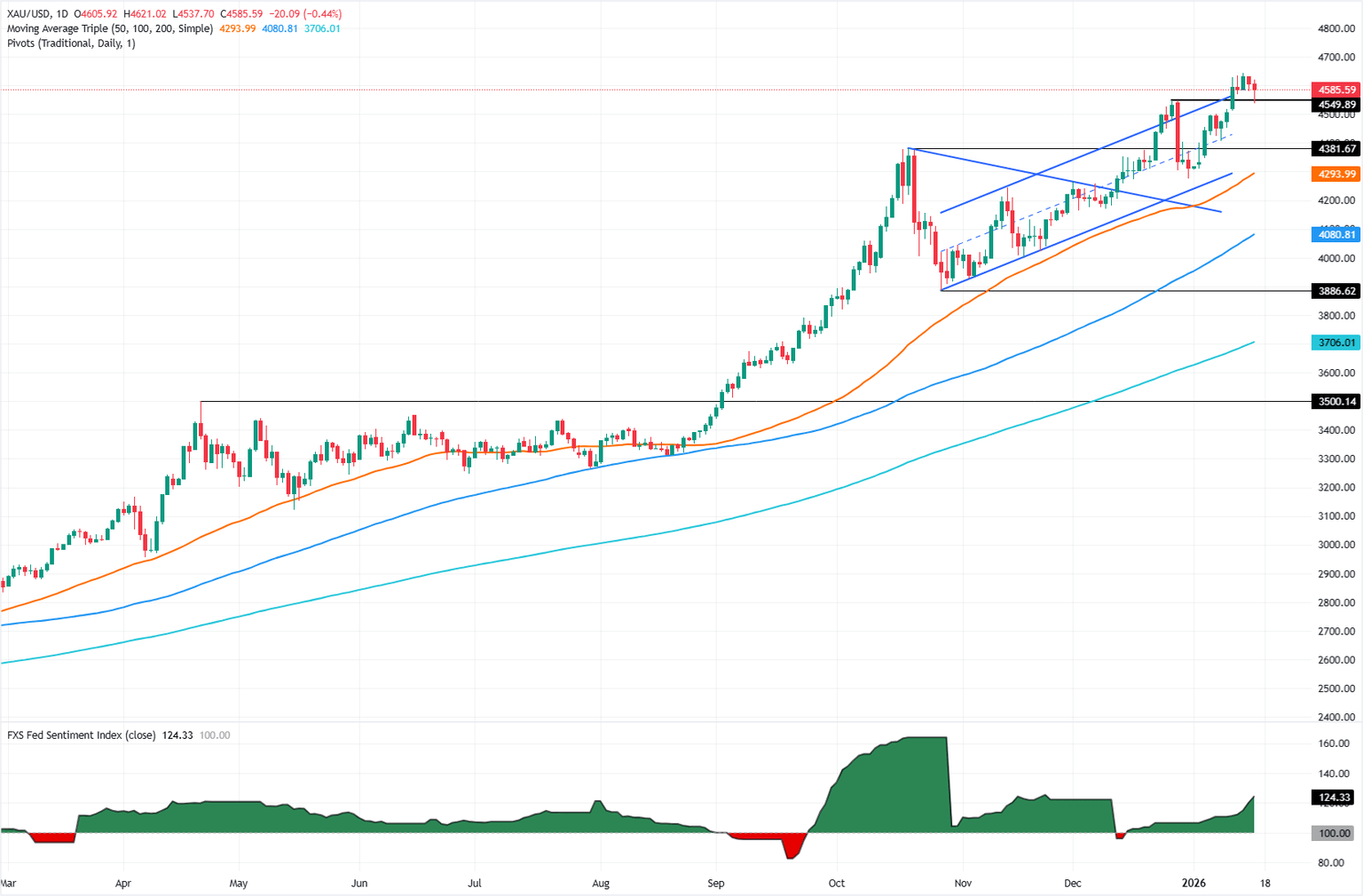
Gold is consolidating below $4,600 after a four-day low of $4,537, but has managed to break above $4,550. The relative strength index (RSI) shows a change from bullish to neutral momentum, but the bears appear to be gaining strength. If RSI clears its neutral line, XAU/USD could challenge the latest low in the cycle at $4,407, which was reached on January 8.
Conversely, if Bullion reaches $4,600, buyers could still hope to break the all-time high (ATH) of $4,643 before reaching the $4,700 target.
Gold FAQs
Gold has played a key role in human history as it has been widely used as a store of value and a medium of exchange. Nowadays, beyond its luster and exploit in jewelry, the precious metal is widely viewed as a safe-haven asset, meaning it is considered a good investment in turbulent times. Gold is also widely seen as a hedge against inflation and currency depreciation because it is not tied to any particular issuer or government.
Central banks are the largest holders of gold. To support their currencies in turbulent times, central banks typically diversify their reserves and purchase gold to improve the perceived strength of the economy and currency. High gold reserves may provide a source of confidence in the country’s solvency. According to data from the World Gold Council, central banks added 1,136 tons of gold to their reserves in 2022, worth about $70 billion. This is the highest annual purchase since registration began. Central banks in emerging economies such as China, India and Turkey are rapidly increasing their gold reserves.
Gold has an inverse correlation with the US dollar and US treasury bonds, which are both major reserve assets and sheltered haven assets. When the dollar depreciates, gold tends to rise, allowing investors and central banks to diversify their holdings in turbulent times. Gold is also inversely correlated with risky assets. A rally in the stock market tends to weaken the price of gold, while sell-offs in riskier markets support the precious metal.
The price may vary due to many factors. Geopolitical instability or fear of a deep recession can quickly cause gold prices to rise due to its safe-haven status. Gold, as a non-yielding asset, tends to rise at lower interest rates, while the higher cost of money tends to weigh on the yellow metal. Despite this, most of the movements depend on the behavior of the US dollar (USD) when the asset is priced in dollars (XAU/USD). A powerful dollar tends to keep the gold price in check, while a weaker dollar will likely cause gold prices to rise.
